MMAP · Progress Reports
A report that reads like the child, not a report card.
No letter grades, no generic rubric. A Montessori whole-child narrative, the developmental arc of a full term, and the child’s own words — composed from the work your guides already document in MMAP. Here are two real examples.
How it comes together
Generated from the work, not the weekend.
Captured across the term
Every lesson presented and practiced, every observation, every work-sample photo, and each child’s assessment data live in MMAP as your guides work. Nothing is re-entered at report time — the record is already there.
Composed by the platform
When the term closes, MMAP assembles it. The developmental scale for each curriculum area — Emerging, Developing, Practiced, Secure — is drawn straight from your guides’ lesson tracking, never typed in by hand. The layout, the school’s branding, and the print-and-share-ready file are the platform’s job.
Written by the guide
The narrative, the child’s quote, and the goals for next term — the seeing and the writing — stay with the prepared adult. MMAP surfaces the term’s real observations alongside the blank page, so the guide writes from documented work rather than end-of-term memory. The platform compiles; it does not compose the child.
The outcome is a report that reflects a full term of real work, in your school’s own voice, produced in an afternoon instead of a lost weekend of copy-paste.
Two real examples
See a full report.
Switch between an Upper Elementary and an Adolescent (Erdkinder) report. Both were generated in MMAP, in the school’s own format.
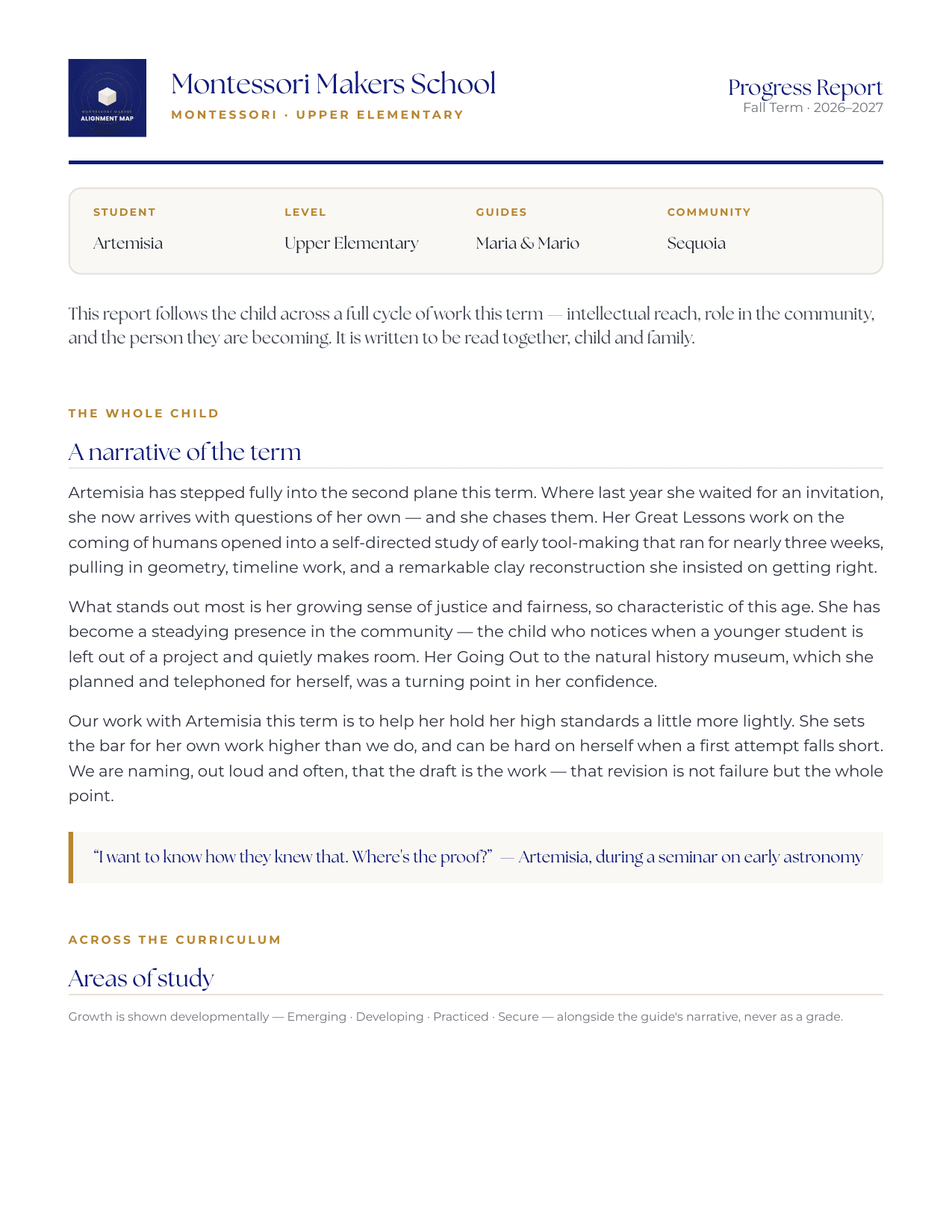
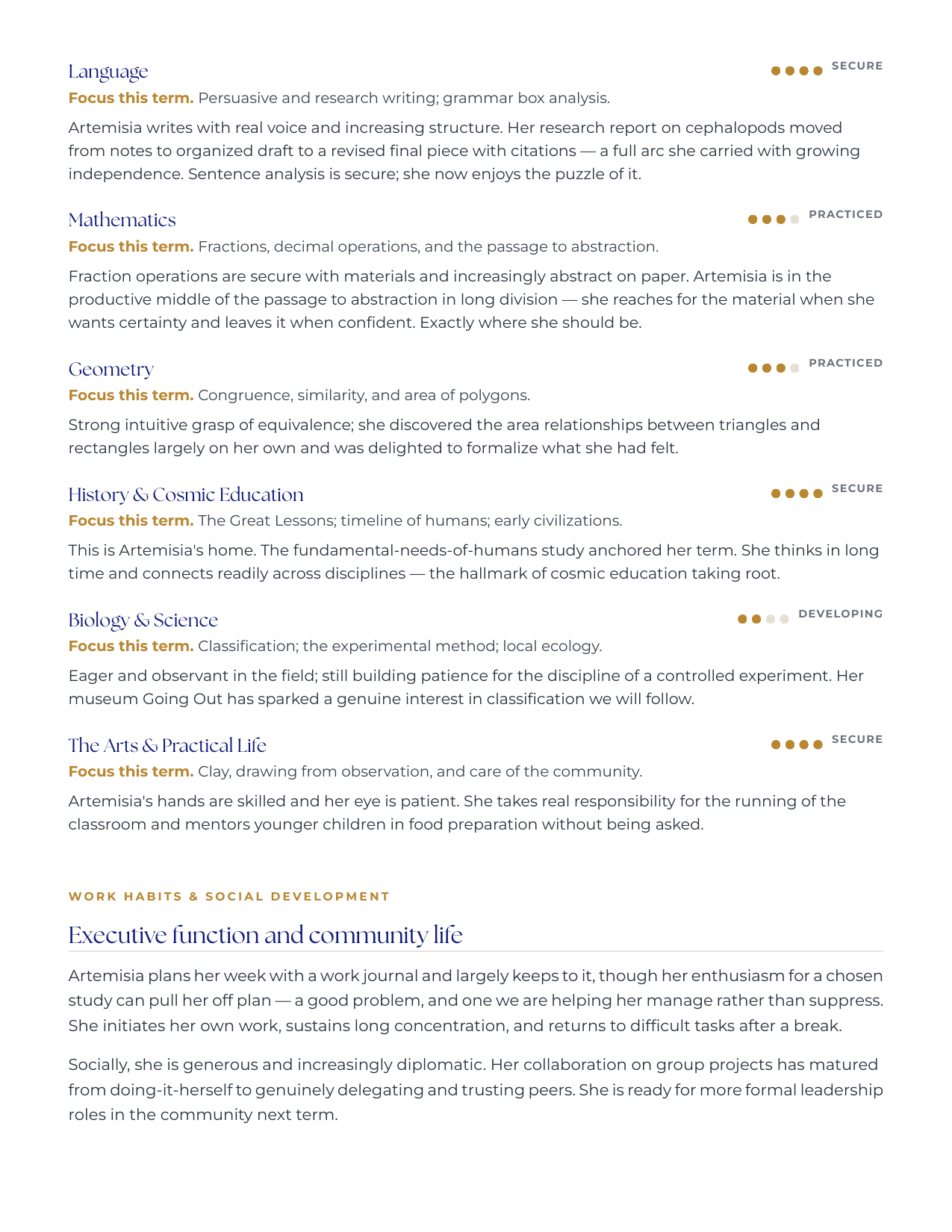
Sample report. Student names and details are illustrative.